
Micromouse: The Fastest Maze-Solving Robot!
Ever wanted to see tiny robots race through a maze like high-tech mice on a mission?

Hey friends,
Yes, you heard that right. Let’s talk about these tiny robots!
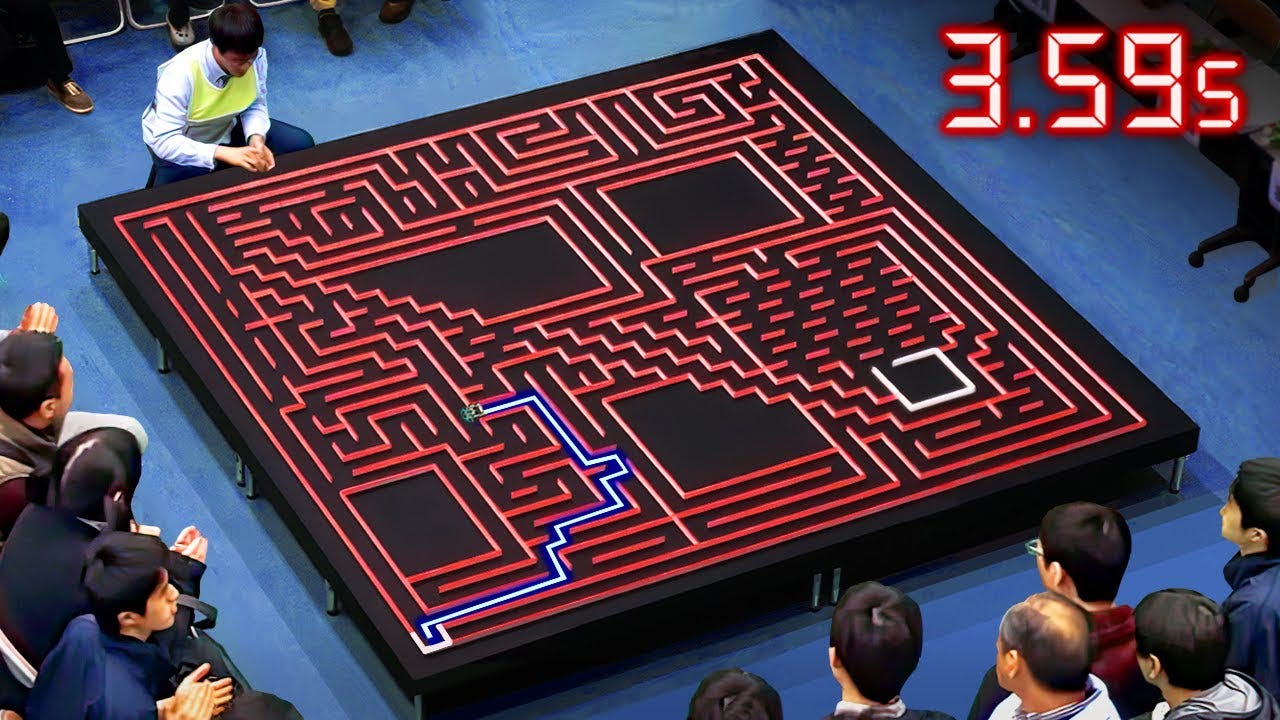
Image Credit: Veritasium
By being part of my robotics team in my high school, I became involved in a lot of robotics. Watching the robot come out of the CAD model and into the workshop is such an amazing feeling. There are so many bits and pieces that make up the robot.
As you see, I was very much surprised to come across a robotics competition - but for miniature robots!
Micromouse, a super fast robotics competition where small autonomous robots (a.k.a. "mice") have to navigate a giant 3 meters x 3 meters maze—all on their own!
A Bit of History (Yep, It's Been Around That Long!)
As surprised as I was already, I was even more shocked to know it has been around since 1952!!
In 1952, mathematician Claude Shannon made an electronic mouse called Theseus. The mouse used the trial and error strategy to go through the maze. As it finds the correct path, it puts it into its memory. After that, it find of died up until 1979.
More importantly, a director at Google said Theseus inspired the whole field of AI!
Then, thanks to the Institute of Electrical and Electronics Engineering, IEEE announced the first big competition in 1979. Over 6,000 people wanted in, but only 15 robots actually made it to the contest.
The winner? A simple wall-following bot called Moonlight Flash.
Since then, the competition has leveled up big time. No more basic wall-huggers—today’s micromice use high-speed algorithms and insane pathfinding skills.
With all this said the current world record is held by Ng Beng Kiat at…3.59 seconds!!!
How Does It Work?
Each robot starts at a set position and has to figure out the fastest way to the center of the maze. Sounds easy? Not so much! The mouse has no clue where the walls are until the start of the match. It has to explore, map out the maze, and decide the best path. It has five runs, and the shortest time taken to reach the middle will be counted.
But what strategy should the mouse take to get to the middle in the shortest time and number of turns? There is a popular technique called the flood and fill method.
Imagine the maze as a grid where each cell is assigned a number representing its distance from the goal (usually the center). The goal cell is set to zero, and each neighboring cell is assigned a value one higher than the previous, creating a gradient of numbers increasing outward from the center. This setup mimics how water would "flood" from the center to the edges, filling each cell step by step.
As the mouse explores the maze, it updates these values in real-time, adjusting for walls and obstacles it encounters. By always moving to the neighboring cell with the lowest value, the mouse effectively follows the "downhill" path toward the goal. Once it reaches the center, the mouse can use this mapped information to determine the shortest and fastest route from the start to the finish.
The flood-fill algorithm is favored because it allows the mouse to dynamically map the maze and adapt to its layout without prior knowledge.
Why Is Micromouse So Popular?
This competition isn’t just for hardcore engineers—it’s a fun mix of problem-solving, tech, and competition. It has spread across the world, with competitions in the U.S., UK, Japan, Singapore, India, South Korea, and more.
Whether you’re into robotics, programming, or just love watching tiny robots race, Micromouse is an awesome way to learn, innovate, and show off some serious skills!
That’s all for this week! See you next Sunday.
Keep learning,
Suhana.